What Is a Token Unlock? Read It Against a US IPO Lockup
Your price-tracking app flags "X% unlocking next week", and anyone who has traded US IPOs thinks of a lockup expiring. How much that unlock really matters depends on whose tokens they are, whether another batch follows, and what the X% is a percentage of.
On a coin's detail page in your price-tracking app, or in a news alert, you may have seen a line like this: "Token ABC unlocks next week, about X% of circulating supply." If you have traded stocks for years, the word "unlock" probably brings to mind the date roughly six months after a US IPO when the lockup expires and insiders are finally free to sell.
That association is a fine place to start. To judge how much that X% really matters, go back to the project's own allocation table and get the numerator and the denominator right.
The US IPO lockup: who is locked, and for how long
According to the glossary entry on Investor.gov, the SEC's investor education site, a lockup agreement bars company insiders from selling their shares for a period after the IPO; those shares are said to be "locked up". Insiders include company employees, their friends and family, and large shareholders. Before the listing, company insiders and the underwriter typically enter into the agreement, so that these shares don't reach the public market too early.
- How long. Terms vary from company to company. In the entry's words: "most prevent insiders from selling their shares for 180 days". So 180 days is the typical length. Some agreements also cap how many shares can be sold within a given period, so the shares don't always all come free on a single day.
- Where the terms are written. US securities law requires a company with lockup arrangements to disclose the terms in its registration documents, including its prospectus.
- Where to look them up. You can find the prospectus in the SEC's EDGAR database.
The entry also carries a warning for anyone trading in the secondary market: "a company's stock price may drop in anticipation that locked up shares will be sold into the market when the lockup ends". In other words, the market may price in the expected selling ahead of time, and the stock can drift lower before the date arrives. The word is may, not will. The SEC's suggestion to investors: if you are considering buying into a newly public company, first find out whether insiders are locked up and when the lockup ends.
Keep three things in mind: who is locked, for how long, and which document holds the terms. On the crypto side, we look for the same three.
Over in crypto, whose tokens does an unlock release?
The mapping isn't hard to find. The shares insiders hold before an IPO correspond, roughly, to the tokens allocated to a project's team and investors. At token generation, the project splits total supply into several buckets: some can circulate from day one, others are released gradually on a schedule. That gradual release is what people call an unlock; project documents usually describe it as vesting or an unlock schedule.
Take Arbitrum's ARB. Its governance docs state an initial supply cap of 10 billion tokens, with inflation of up to 2% a year after that. After proposals AIP 1.1 and 1.2 passed, the allocation looks like this:
- ArbitrumDAO treasury: 35.28%, 3.528 billion tokens
- Team and contributors (including advisors): 26.94%, 2.694 billion tokens
- Investors: 17.53%, 1.753 billion tokens
- User airdrop: 11.62%, 1.162 billion tokens
- Arbitrum Foundation: 7.5%, 750 million tokens
- DAOs building apps on Arbitrum (airdrop): 1.13%, 113 million tokens
Team and investors together hold more than 40%, and they are this project's equivalent of insider shares. The lockup terms sit in the "Vesting and lockup details" section of the docs: "all investor and team tokens are subject to 4 year lockups, with the first unlocks happening one year after the token generation event (3/16/2023) and then monthly unlocks for the remaining three years".
In stock-investor terms: team and investor tokens are locked for four years in total. The token generation event (TGE) took place on March 16, 2023, and is where the lockup clock starts, much like the IPO date for a stock; the first unlock comes a full year later, and over the remaining three years another batch is released every month.
The Foundation's 7.5% runs on a separate track: it unlocks linearly over four years from April 17, 2023, with the release handled by the Foundation's Vesting Budget smart-contract wallet (the circulating-supply page calculates it from 700 million tokens in the vesting contract plus an initial 50 million, per the footnotes covered below). The circulating-supply page says its first unlock happened on April 17, 2023, after which the tokens "continue to unlock every second". The two airdrops became claimable when distribution started on March 23, 2023, and the claim window closed on September 24, 2023.
Reading a real unlock table: ARB's first unlock in March 2024
Arbitrum's governance docs have a page devoted to circulating supply. It defines circulating supply as the number of tokens that can currently be transferred and used on the network, calculated from the initial allocation plus the unlock schedules for the team, investors and contributors. The page has two tables, one as of March 7, 2024 and one projecting March 17, and together they bracket the team and investor first unlock on March 16. I have merged the two into one:
| Allocation | Total allocation | Circulating, 2024-03-07 | Projected circulating, 2024-03-17 |
|---|---|---|---|
| ArbitrumDAO treasury | 3.528B | 126,131,267 | 126,131,267 |
| Team and contributors | 2.694B | 0 | 673,500,000 |
| Investors | 1.753B | 0 | 438,250,000 |
| Users (airdrop) | 1.162B | 1,092,551,615 | 1,092,551,615 |
| Arbitrum Foundation | 750M | 205,715,264 | 210,506,502 |
| DAOs building apps on Arbitrum | 113M | 113,000,000 | 113,000,000 |
| Total | 10B | 1,537,398,145 | 2,653,939,384 |
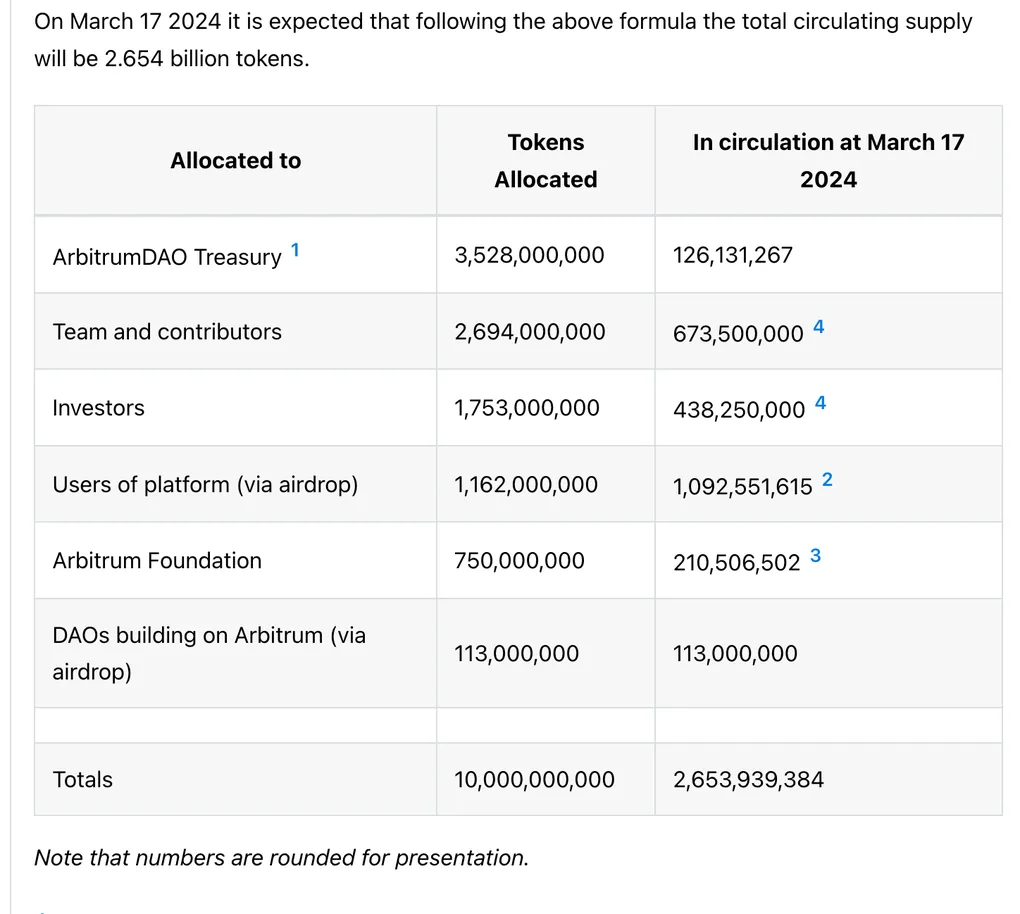
Read the two tables side by side and the story is in the team and investor rows. On March 7, circulating supply for team and contributors and for investors was 0, the equivalent of insider shares still in lockup. By March 17, those two rows read 673.5 million and 438.25 million. The other rows barely moved; only the Foundation row rose, from 205,715,264 to 210,506,502, and that small ten-day increase fits its unlock-every-second schedule.
Running the numbers from the table: the team and investor first unlock totals 1,111,750,000 tokens, about 72% of the 1.537 billion circulating on March 7. Total circulating supply went from roughly 1.537 billion to roughly 2.654 billion. The team's 673.5 million is also exactly a quarter of its 2.694 billion allocation, and the investors' 438.25 million is likewise a quarter of 1.753 billion. Set that against the terms (a four-year lock, first unlock after one year) and it works out to one year's share of a four-year allocation.
Put in stock terms: one year after a listing, the locked insider shares release a single batch equal to more than 70% of the float at the time. Anyone who has traded US IPOs would probably circle that date on the calendar. Circling it is not the same as drawing a conclusion, though, and even for stocks the SEC's wording stops at "may".
Where the comparison with an IPO lockup breaks down
The length and rhythm differ. A US lockup commonly runs 180 days; ARB's team and investors had to wait out a full year, and their tokens then unlock monthly over the following three years. A stock lockup revolves around a single expiry date, while an arrangement like ARB's is a string of dates, with another batch every month after the first. The one that shows up on an unlock calendar may be just one date in that string.
The terms live in different places. US lockup terms go into the prospectus, which you can pull up on EDGAR. ARB's unlock terms are written in Arbitrum's own governance docs, and the release of the Foundation's allocation is carried out by a smart-contract wallet. Move on to another project and you have to go through that project's documentation from scratch.
There is a per-second rhythm you never see in stocks. The stock lockups Investor.gov describes either open up at expiry or cap how much can be sold within a period. ARB's Foundation allocation unlocks every second, so no single day stands out, and there is hardly a date to mark for it on an unlock calendar.
Circulating supply comes out of a formula, so figures can conflict. The footnotes on Arbitrum's circulating-supply page spell out several calculation choices: unlocked amounts for the team, investors and contributors count one month as the number of seconds in a year divided by 12, starting from March 16, 2024; unclaimed airdrop tokens were moved to the DAO treasury but are still recorded in the users row of the table; and the Foundation's unlocked amount is based on 700 million tokens in the vesting contract plus the initial 50 million. Add in up to 2% annual inflation on total supply, and different websites can show different ARB circulating supply figures without anyone getting it wrong; they may simply be counting differently. To understand circulating supply alongside fully diluted valuation (FDV), carry on with how to read market cap, circulating supply and other crypto metrics.
Next time an alert says X% unlocks next week: three steps
Step 1: Go back to the official docs for the allocation table and unlock terms
Unlock calendars and price-app alerts are secondhand information. Go to the project's official documentation and find two things: the token allocation table, and the vesting or lockup terms. It is the same move as the SEC telling you to check the prospectus, just in a different place. For ARB, the allocation table and lockup terms both sit on the distribution specifications page of Arbitrum's governance docs, and circulating supply calculated from the schedule has a page of its own.
Step 2: Work out the unlock as a share of current circulating supply
The numerator is the size of this unlock; the denominator is circulating supply before the unlock, not total supply. For pre-unlock circulating supply, look first for the figure the project itself publishes; if it doesn't give one, use a market-data site's number and note whose methodology it is. Back to that ARB unlock: roughly 1.11 billion tokens is only just over a tenth of the 10 billion total, but more than 70% of the 1.537 billion circulating at the time. Same unlock, wrong denominator, and your sense of its weight is off several times over.
Step 3: Tell a one-off unlock from a linear release
A first unlock like ARB's, one year in, releases a quarter of the four-year allocation in one go; this is what's known as a cliff. ARB then unlocks monthly for three years, a small amount each time, while a per-second linear release barely has a noticeable date at all. How much another project releases at once depends on its own terms. Two alerts can both say "X% unlocking", but everything landing in a single day and a slow release over several years affect the float in different ways, so don't treat the same percentage as the same weight.
My own take: treat an unlock as a known date on the schedule, the way you would an earnings date. Put it in your calendar and work out the ratio, but don't treat it as a buy or sell signal. Whether holders sell after the unlock, and how much, is something no schedule can answer. Whether a project is worth holding still comes back to crypto fundamentals; for the other rules where tokens and stocks differ, see the 12 key differences between stocks and crypto.
FAQ
Is a token unlock the same thing as a US IPO lockup expiring?
The core idea is shared: people who got in early have to wait out an agreed period before their holdings can reach the market. The details differ quite a lot. A US lockup is an agreement between insiders and the underwriters, and its terms have to be disclosed in the prospectus; a token unlock schedule is written by the project into its own documentation, and the release pattern is far more granular. ARB's team and investor allocations, for example, release monthly after a full year's lock, while the Foundation's allocation releases every second.
Does the price always fall once the unlock date arrives?
There is no such certainty. Even for stock lockups, the SEC only says the share price may fall early in anticipation of selling. An unlock just means those tokens can be transferred and sold from that day on; whether holders sell, and when, is not something the schedule shows. What you can do is size the unlock accurately and set it against circulating supply before the unlock.
Where can I find a token's unlock schedule?
Search the project's official documentation for terms like vesting and lockup. Third-party unlock calendars work well as reminders, but check the numbers against the official docs; ARB's allocation and lockup terms are on the airdrop and distribution specifications page of its governance docs.
What is the difference between X% of circulating supply and X% of total supply?
The denominator. A share of total supply tells you how big this batch is relative to all tokens, which is more useful for gauging long-term dilution; a share of circulating supply compares this release with what is already tradable on the market. The two numbers can differ several times over, so check which denominator an alert is using first.
Further reading
- Investor.gov: Initial Public Offerings: Lockup Agreements — the SEC's glossary entry on IPO lockup agreements, covering who is locked, for how long, and where to look.
- Arbitrum governance docs: $ARB airdrop eligibility and distribution specifications — ARB's allocation percentages and the original lockup terms for the team, investors and Foundation.
- Arbitrum governance docs: What is the token circulating supply? — the definition of circulating supply, the two tables from around March 2024, and the footnotes on methodology.