What the Binance Monitoring Tag Means, Compared With an A-Share ST
Like ST, the “special treatment” prefix on a mainland Chinese A-share, Binance's Monitoring Tag is a risk flag the exchange puts on in public. PIVX got the tag on June 18, 2026, and Binance's delisting notice set its withdrawal cutoff for October 17, 121 days later.
On June 18, 2026, Binance announced it was adding the Monitoring Tag to four tokens: ACT, BLUR, PIVX and QKC. Sixty days later, at 03:00 UTC on August 17, PIVX stopped trading on Binance spot and was delisted. The other three were still trading as of October 10, 2026.
The nearest thing in mainland China's A-share market is ST: a prefix the exchange puts in front of a stock's short name when its risk has grown, to tell you something is wrong with the company. Only the starred version, *ST, is a delisting risk warning; plain ST covers other risks and does not mean the stock is on its way out. Reading the Monitoring Tag as that kind of risk flag points you the right way. The tag says a token may be delisted; whether it will be, and on what day, the tag can't tell you.
Monitoring Tag: Binance's public flag on higher-risk tokens
The Monitoring Tag arrived on the same day as the Seed Tag. On July 26, 2023, Binance announced both, giving as its reason community feedback that users found it hard to tell tokens in the innovation zone from those in the main trading zone. The Seed Tag took over from the innovation zone and covers the tokens of innovative projects; the Monitoring Tag covers the other end, tokens already listed on Binance whose risk is rising.
Binance Academy's glossary entry for the Monitoring Tag (updated Aug 28, 2026) says it identifies “cryptocurrency tokens that exhibit higher volatility and risk compared to other listed tokens”, and that these tokens “are subject to close observation by Binance and may face delisting if they fail to meet ongoing listing criteria”. The entry closes with a reminder: “The presence of a Monitoring Tag means a token is at risk of being removed from the Binance platform.”
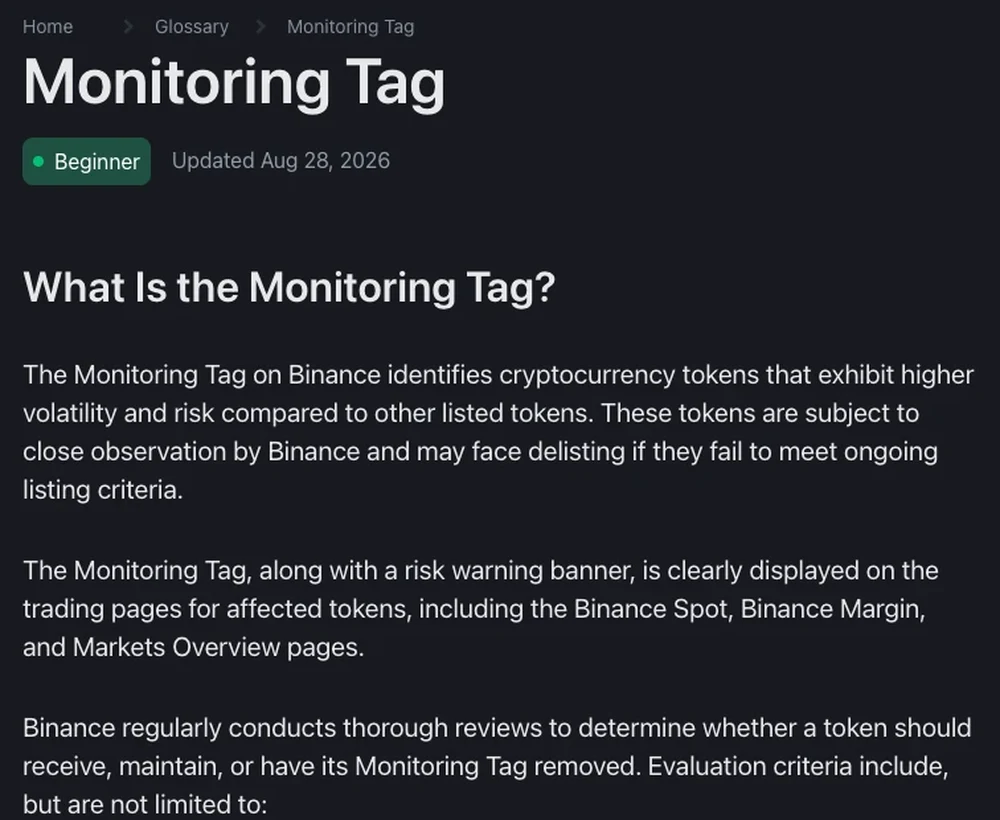
Who gets the tag and who loses it is Binance's call alone: it “regularly conducts thorough reviews to determine whether a token should receive, maintain, or have its Monitoring Tag removed”. The 2023 announcement listed eight factors for those reviews: the team's commitment to the project, the level and quality of work on it, trading volume and liquidity, the stability of the network and smart contracts, upkeep of the community, responsiveness to Binance's periodic reviews, any unethical or fraudulent conduct, and contribution to the wider blockchain ecosystem. Of the eight, an ordinary holder can check trading volume and liquidity directly in a market app, the same place you would read market cap and supply; most of the rest has to be pieced together from what the project team is doing.
The tag shows on the trading pages for the token, including Binance Spot, Binance Margin and the Markets Overview page, together with a risk warning banner. Those three places were named at the 2023 launch, and the Academy entry lists the same three today.
Trading takes one extra step, spelled out in the June 18, 2026 tagging announcement: “To gain trading access to tokens marked with the Monitoring Tag, users will need to pass the quiz every 90 days on the Binance Spot and/or Binance Margin platforms, and accept the Terms of Use.” In plain terms, buying or selling a tagged token means answering a quiz and agreeing to the terms before you get trading access, and doing it again every 90 days. The 2023 launch announcement set the same 90-day quiz for Seed Tag and Monitoring Tag tokens alike.
A tag doesn't drag other products down with it. “Other services related to the aforementioned tokens will not be affected,” the same announcement says, and the 2023 one has a sentence to the same effect. Read that way, the moment a tag goes on, what gets added is a risk warning banner and the quiz before trading.
On the risk of delisting, the June 18 text reads: “Keep in mind that tokens with the Monitoring Tag are at risk of no longer meeting our listing criteria and being delisted from the platform.”
The first batch in 2023 put the tag on 26 tokens, among them FTX Token (FTT), Multichain (MULTI), Tornado Cash (TORN), Voyager (VGX), WazirX (WRX), Enzyme (MLN) and JasmyCoin (JASMY). MLN comes up again below.
PIVX's 121 days: from Monitoring Tag to the end of withdrawals
Forty-six days after PIVX got the tag, on August 3, 2026, Binance published a delisting notice that set August 17 as the spot delisting date for six tokens: ACX, HFT, PIVX, PYR, VANRY and VIC. Of the six, PIVX is the one that was on the June 18 Monitoring Tag list, and it is the only one followed here.
The notice gives the times at which the tokens leave Binance's products, with a caveat: “The delisting schedule may or may not apply to the products listed below, depending on their association with the token(s) being delisted.” It doesn't say token by token which products PIVX was part of, so the table below is the schedule common to all six, and it covers only some of the products the notice lists. The rows that certainly apply to PIVX are the tag, the spot delisting, and deposits and withdrawals. In date order, with times in UTC:
| Date (UTC) | What happens (as scheduled in the notice; product rows where applicable) |
|---|---|
| 2026-06-18 | Binance announces the Monitoring Tag for ACT, BLUR, PIVX and QKC |
| 2026-08-03 | Delisting notice published; PIVX and five other tokens set for delisting on August 17 |
| 08-04 03:00 | Buy & Sell Crypto delists the tokens (where applicable) |
| 08-04 06:00 | Margin suspends borrowing of the tokens (where applicable) |
| 08-07 03:00 | Binance Pool stops mining support; Binance Pay delists |
| 08-07 07:00 | VIP Loan and Flexible Loan close all outstanding loan positions |
| 08-07 08:30 | No new futures positions can be opened |
| 08-07 09:00 | Futures positions closed and settled automatically; contracts delisted after settlement |
| 08-07 10:00 | Removed from Cross and Isolated Margin |
| 08-10 03:00 | Spot Copy Trading delists; outstanding assets force-sold at market price |
| 08-10 07:00 | Simple Earn delists; positions redeemed automatically |
| 08-14 02:00 | Convert Low-Value Assets delists |
| 08-17 02:00 | Binance Convert delists |
| 08-17 03:00 | Spot trading ceases and the pairs are delisted; all open orders removed automatically; Trading Bots terminated |
| After 08-18 03:00 | Deposits of PIVX are no longer credited |
| After 10-17 03:00 | Withdrawals no longer supported |
| After 10-18 03:00 | Remaining PIVX “may be converted into stablecoins on behalf of users”; the conversion is not guaranteed |
Leverage is shut off first. The day after the notice, alongside Buy & Sell Crypto, margin borrowing was scheduled to be suspended; within a few hours on August 7, VIP Loan and Flexible Loan, futures, and Cross and Isolated Margin were scheduled out one after another. Spot trading was left for last. Our reading of that order: loan and futures positions carry margin and liquidation rules, so the platform has to clear them before spot trading stops. Those are the same rules that decide how a futures liquidation price is calculated.
Several of these steps don't wait for you. Four rows in the table are carried out by the platform (they only matter if the token was part of that product): loan positions are closed, futures positions are closed and settled, unsettled copy-trading assets are force-sold at market price, and PIVX in Simple Earn is redeemed automatically. For anyone using those features, the position is dealt with by rule when the time comes; choosing your own price means acting before then.
After spot trading stops, the notice leaves 61 more days for withdrawals. Spot trading ceased at 03:00 UTC on August 17, and the notice sets the withdrawal cutoff at 03:00 UTC on October 17, 2026. In that window PIVX stays in the holder's Binance account and can be withdrawn, while the ways of swapping out of it that the notice lists (spot, Binance Convert, Convert Low-Value Assets) are already closed. The notice also flags a detail: after delisting, the token's valuation is no longer displayed in the account, so to keep seeing the balance, make sure Hide Small Balances is not selected. Deposits of PIVX stopped being credited after 03:00 UTC on August 18, and whatever is still in an account after October 18 may be converted into stablecoins by the platform, a conversion the notice says is not guaranteed.
The delisting notice also lists the metrics Binance weighs when deciding whether to delist. Among them: new regulatory requirements; a material or unjustified increase in token supply, or changes to tokenomics; changes to the project's ownership structure or core team members; community sentiment; and the level of public communication, community engagement and transparency. In stock terms, that is a large share issue, a change in shareholding structure, a new controlling shareholder and poor disclosure.
On the dates in the notice, PIVX goes from tag to the end of withdrawals in 121 days. That is one token on one occasion; the 46-, 14- and 61-day gaps can't be carried over to another token.
How close is the Monitoring Tag to an ST stock in the A-share market?
What the two share, first, is that both are out in the open. ST sits in front of the stock's short name, visible the moment you open a quote screen; the Monitoring Tag sits on Binance's Spot, Margin and Markets Overview pages, with a risk warning banner beside it. In both cases the exchange is telling you, unprompted, that the risk on this asset has gone up. What they point to overlaps only in part. *ST warns investors that the stock is at risk of delisting, while plain ST is a warning for other risks (a company that falls short on dividends can get one) and does not point to delisting. The Monitoring Tag warns that a token may be delisted, which puts it closer to *ST. Both can also come off: in A-share slang, a stock whose ST is lifted has taken off its hat, and a Binance review can end with the tag removed.
The first difference is scope. An ST belongs to the stock itself: whichever broker you opened your account with, the short name carries it. The Monitoring Tag is applied by Binance against its own listing criteria and appears only on Binance; whether another exchange marks the same token is up to that exchange's rules. How an exchange lists and delists tokens is one more thing to weigh when you choose a crypto exchange.
The ending differs too. A token is recorded on its own chain, and what Binance delists is the trading and services for it on Binance's platform. That is why, after PIVX spot trading stopped, the notice left two months for withdrawals: time for holders to move their coins out. Where the coins go next depends on what a crypto wallet is and which kind you pick.
Tagged, and still trading nearly four months later
The four tokens tagged on June 18 have already gone separate ways. On October 10, 2026, Binance's public exchangeInfo endpoint showed ACTUSDT, BLURUSDT and QKCUSDT with the status TRADING, and PIVXUSDT with BREAK, meaning trading had stopped. All four were tagged on the same day; 114 days on, three were still trading and one had been delisted.
MLN (Enzyme) is the longer-running example. It was among the 26 tokens in the first Monitoring Tag batch on July 26, 2023. On May 13, 2026, Binance announced that MLN would be delisted on May 27 together with ATA, FARM, PHB and SYS, nearly three years after that first list. Those two announcements fix the start and the end; they don't show whether the tag stayed on without a break in between. On October 10, 2026, the same endpoint showed MLNUSDT as BREAK as well.
Monitoring Tag vs A-share ST, side by side
| Item | Binance Monitoring Tag | A-share ST |
|---|---|---|
| Who applies it | Binance, against its own listing criteria | The stock exchange, to the stock itself |
| Where you see it | Binance Spot, Margin and Markets Overview pages, plus a risk warning banner | The ST or *ST prefix in front of the stock's short name |
| What it warns of | Higher risk than other listed tokens; may be delisted | ST: other risk warning; *ST: delisting risk warning |
| Can it come off? | Yes, Binance reviews tags regularly and can remove one | Yes, the exchange can remove the ST marker |
| How it ends | Delisted from Binance, with a withdrawal period after trading stops | Delisted from the exchange |
A Monitoring Tag means Binance has singled the token out and trading it takes an extra quiz; the delisting date comes in a separate notice. In PIVX's case, that notice came 14 days before spot trading stopped and 75 days before the withdrawal cutoff.
Monitoring Tag FAQ
Will a token with the Binance Monitoring Tag be delisted?
It may be, but there is no fixed interval between getting the tag and being delisted. Binance Academy's entry says the tag means a token is at risk of being removed from the Binance platform; in the PIVX and MLN cases, the delisting was announced in a separate notice.
Can you still trade a token that has the Monitoring Tag?
Yes. To trade one on Binance Spot or Margin you need to pass the quiz and accept the Terms of Use, and that trading access has to be renewed every 90 days. The tagging announcement states that other services related to the tokens are not affected.
What is the Seed Tag?
The Seed Tag was introduced on July 26, 2023, the same day as the Monitoring Tag, to replace Binance's old innovation zone: the tokens then in that zone all moved to the Seed Tag, and tokens of innovative projects listed afterwards get it too. Going by the title of that announcement, both tags are there to help users identify high-volatility, high-risk tokens. The Seed Tag is for new projects, the Monitoring Tag for tokens already listed that are at risk of no longer meeting the listing criteria, and trading either one requires the quiz.
Should I sell a token as soon as it gets the Monitoring Tag?
This site doesn't give buy or sell advice. A few things you can check for yourself: look through Binance's announcements to see whether the token appears in a delisting notice. If you use margin, loans, futures, copy trading or Earn, note that in the PIVX delisting notice those products, wherever the token was part of them, were scheduled to stop before spot trading, with positions closed, settled or redeemed automatically by the platform. If the coins sit on Binance, PIVX holders were given about two months to withdraw after the delisting, and tokens left after that may be converted into stablecoins.
Sources
- Binance announcement of July 26, 2023 introducing the Seed Tag and the Monitoring Tag: why the two tags were created, the 90-day quiz rule, the first 26 Monitoring Tag tokens and the eight review factors.
- Binance Will Extend the Monitoring Tag to Include ACT, BLUR, PIVX & QKC on 2026-06-18: the announcement that tagged PIVX, and the source of the quiz wording and the listing-criteria warning quoted above.
- Binance Will Delist ACX, HFT, PIVX, PYR, VANRY, VIC on 2026-08-17: the source of the timeline, with the stop time for each product and the delisting metrics.
- Binance delisting notice of May 13, 2026 (ATA, FARM, MLN, PHB and SYS, delisted May 27): where MLN enters a delisting list.
- Binance Academy glossary: Monitoring Tag: the definition, where the banner is shown and the regular reviews.