Staking Rewards vs Stock Dividends: What Actually Changes
If you have collected dividends for years, "hold it and it pays you" is a familiar idea. Crypto has something that looks like it — staking, savings products, liquidity provision. The mechanics underneath are different in four ways that catch stock investors out, and every one of them is worth knowing before you lock anything up.
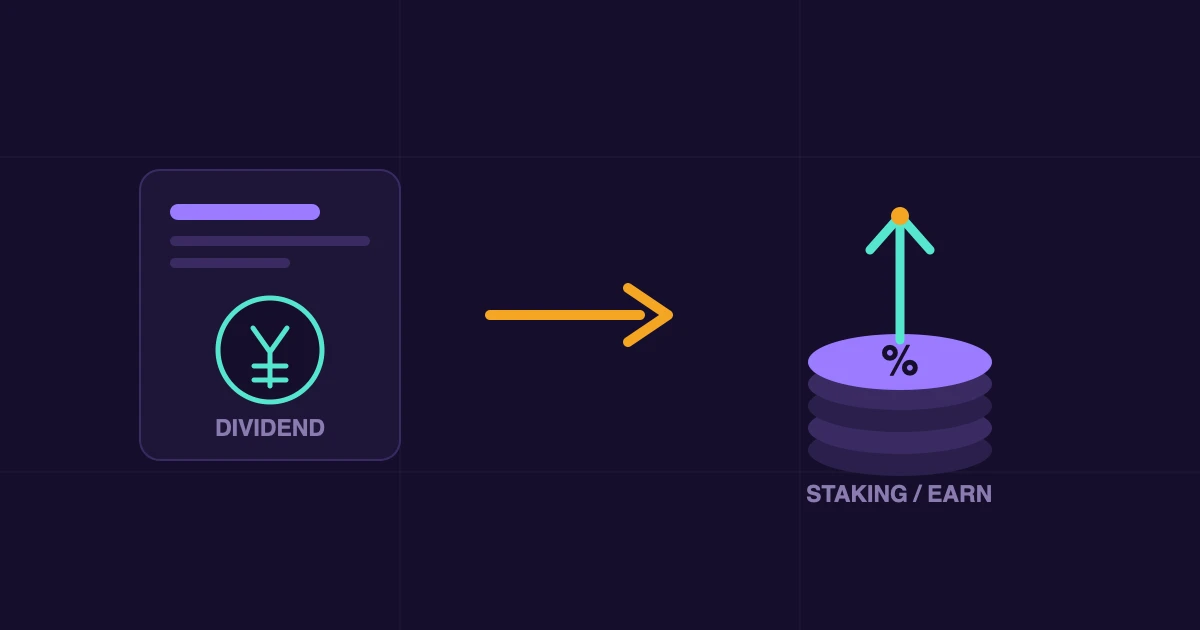
Dividends are one of the first things a long-time stock investor learns to like: you hold the shares, the company hands you cash, and the cash does not depend on you selling anything. Crypto has grown its own version of "hold it and it pays you" — you will see it called staking, savings, earn, or liquidity provision. The label fits loosely. The machinery underneath does not.
This piece lines the two up: what a dividend really is, what crypto pays instead, the three routes a beginner actually meets, how to read APR against APY, and the four differences that most often catch stock investors out. Educational information only, not investment advice; availability and rates follow whatever Binance's page shows at the time.
First, what a dividend actually is
To use an analogy well, get the original right. A dividend is a company handing shareholders a slice of the profit it earned, in proportion to how much you hold. The board decides how much of the year's earnings to distribute; you receive cash (sometimes stock) according to your position. Three features you long stopped noticing are exactly the ones that matter here:
- It comes out of profit. The money underneath a dividend is real operating profit — earnings from a business, passed to you. The source is legible.
- It arrives as cash. Most dividends land in your account as ordinary money, separate from what the share price is doing.
- It is relatively predictable. Mature companies build dividend habits, and dividend yield (dividend per share ÷ share price) is a number you can calculate and compare across names — you can even screen for it.
Hold on to those three: profit-driven, paid in cash, relatively predictable. Every one of them gets rewritten on the crypto side.
Does crypto have dividends? Yes, under another name
Strictly speaking, most crypto assets have no company behind them earning profit, so there is no dividend in the traditional sense. What the market did grow is several mechanisms for earning while holding — a rough crypto counterpart to putting money to work, except what you receive is coins, and the source is different:
- Staking. Many chains run on proof of stake: you lock coins into the network to help validate and secure it, and the network pays you newly issued coins by rule. The source is not a company's profit — it is protocol issuance plus transaction fees.
- Savings and lending. You deposit coins into an exchange or platform product, the platform lends them out to people who need funding (traders using leverage, for instance), and passes you a share of the interest. This is the closest thing to the deposit interest you already know, with the denomination swapped for coins.
- Providing liquidity in DeFi. Acting as a market maker on a decentralised exchange and earning a cut of trading fees. This one is advanced; understand it, but do not start here.
For someone arriving from equities, our advice is blunt: get the first two straight and that is enough for a long while; leave the third until you are settled in this market. If you want the underlying assets clear first, what Bitcoin is and what Ethereum is are the place to go — Ethereum being the textbook proof-of-stake asset you can actually stake.
The three main routes to earning on holdings
In practice, on a mainstream platform, what a beginner meets first is a packaged "earn" section. Inside it the products split roughly as follows — easier to read against instruments you already know:
- Flexible savings — like a money market fund you can exit any day. You can submit a redemption whenever you want, which is the most flexibility on offer, and in exchange the annualised rate is usually the lowest of the three. Being able to ask is not the same as getting it instantly, though: Binance's own terms set a daily redemption quota per flexible product that can change at any time, note that redemption may be delayed in extreme markets or when demand spikes, and anything pledged as loan collateral has to be released first. Suits stablecoins you are not using right now but do not want completely idle.
- Locked savings — like a term deposit. You agree to lock the funds for a set period (7 to 90 days is common), cannot withdraw during it, and get a somewhat higher rate. Note what is actually locked: your money. The rate itself is often still floating and can move daily.
- Staking — handing proof-of-stake coins to the network for network rewards. Assets like ETH get locked in to do work and earn newly issued coins. Some support redeeming any time, others require a lock-up; the platform normally packages the technical steps so it is a few taps.
Which to choose comes down to whether you value "can get it back any time" or "a slightly better rate" — precisely the trade-off you make at a bank between instant access and a term deposit. Which products exist, what the annualised numbers are, and whether a lock-up applies: all of it follows what Binance's own page shows at the time. Any number written by a third party, including this article, can go stale.
APR and APY: how to read that percentage
Two abbreviations show up constantly on these products. Set them against what you already know and they stop being intimidating:
- APR — the simple annualised rate, ignoring compounding. It tells you the nominal points per year.
- APY — the annualised return with compounding (interest earning interest) factored in. Same underlying rate, and the more frequently it compounds, the further APY sits above APR.
This is the same distinction as a bank's nominal rate versus what actually lands. Two things to check on any product: whether the figure quoted is APR or APY, and whether it is fixed or floating. Plenty of crypto products quote a floating APR that moves daily, sometimes minute to minute — the number you see today is not the number you earn every day of a lock-up. To get a feel for what time plus compounding does over the long run, our DCA calculator is worth a few minutes; it models regular buying rather than yield, but the compounding intuition carries over.
Four ways it differs from a dividend
This is the section to remember. Both arrangements pay you for holding, and they differ in four structural ways that anyone who has been burned will recognise:
One: you are paid in coins, not cash. A dividend lands as actual money. Staking and savings rewards usually pay you more of the same coin. That makes your return coin-denominated: nominally you hold 5% more coins, but if the price fell 20% over the same window, you are down in money terms. Do not let "5% annualised" do your thinking — ask 5% of what. Read this together with crypto has no daily price limits: the price swing is routinely far larger than the yield.
Two: the rate floats, it is not contracted. A high-dividend stock is relatively predictable. Crypto annualised rates move — 4% today, possibly 2% next week, with nobody underwriting it. Treat it as floating interest set by the market, not as a stable income stream.
Three: lock-ups cost you liquidity. Locked savings and some staking require you to commit for a period. During the lock-up you can neither withdraw nor step aside from a falling price. A dividend never asked you to promise not to sell for three months. Before locking, ask plainly: am I certain I will not need this money in that window?
Four: there is an extra layer of platform and protocol risk. A dividend sits behind a regulated listed company. Crypto yield sits behind an exchange or an on-chain protocol. Whether the platform runs into trouble, whether the contract has a flaw, whether the chain itself is sound — all new risk. Which is exactly why picking a solid venue matters far more than squeezing out an extra fraction of a percent; how to choose a crypto exchange covers the criteria.
Starting out without getting burned
If the idea of idle money earning something appeals and you want to try, a few practical rules. The core of it is one line: go for steady first, do not chase the high rate.
- Start with stablecoins in flexible savings. Using a stablecoin like USDT keeps the unit of account relatively still, so you can run the whole loop — subscribe, redeem, see the reward arrive — before anything else moves under you.
- Treat the annualised figure as a reference, not a promise. An implausibly high rate should trigger caution, not appetite. Legitimate products do not offer guaranteed high yield.
- Small size, in stages, not all at once. Yield is a bonus, not your reason for being in this market. Do not lock away cash you should be keeping just to earn a bit more interest.
- Check whether there is a lock-up and whether you can redeem on demand before deciding which product and how much.
One last flag: anything flying the "staking / savings / yield" banner while promising a fixed high return, paying you for recruiting others, or pressing you to deposit quickly, is running the standard script of a scam. No platform underwrites a guaranteed profit. How these setups work is covered in common crypto scams for stock investors — worth reading before you act. For the systematic comparison of equities against crypto, go back to the key differences between stocks and crypto, or restart the whole thread from the stock investor's guide to crypto.
FAQ
Is staking the same as receiving a dividend?
No. A dividend distributes company profit and pays you in cash; staking pays newly issued coins for helping run the network, and the rate floats. The similarity stops at "you get paid for holding".
If the annualised rate is 5%, am I up 5%?
Only in coin terms. You hold 5% more coins; measured in money you are up or down depending on what the price did. This is the single most common misreading for someone arriving from equities.
Should a beginner pick flexible or locked?
Flexible, to start. Learning the subscribe-and-redeem loop with money you can pull back matters more than the extra fraction of a percent a lock-up pays. Consider locked products only once you are sure you will not need the funds.
Is a higher annualised rate better?
No — an unusually high rate is a question, not a feature. Ask where the yield comes from and who bears the risk. Anything promising fixed high returns should be treated as a warning sign.
Further reading
- Ethereum.org: staking — the official explanation of how proof-of-stake rewards work.
- Binance Academy: What Is Staking — an illustrated primer on the mechanism.
- Investopedia: dividend yield — a neutral definition of the equity-side original.
- Investopedia: APY — why compounding puts APY above APR.